Lara Putnam’s article was written in 2016, just as I was arriving in the United States and beginning my English studies at NOVA. Before that, while living in Germany, I had already bought a digitizer for about 250 euros and digitized more than 5,000 family photographs, including negatives and slides, along with letters, postcards, birth certificates, and other family documents. I organized all of them in a smart-data format, using dates and identifying information. I also sent copies to members of my family. In a way, I had already become our family archivist.
Since then, the digital world has advanced at an extraordinary speed, sometimes seeming almost impossible to keep up with. When Putnam wrote this article, we did not yet have generative AI tools like ChatGPT or Google Gemini as part of everyday life, and digital research was still developing in ways that now seem almost modest compared with what we have today.
Putnam also points out that digital searches influence which sources historians see and use. Not every source is equally visible, and this can shape a historian’s understanding of the past.
I would add that this issue becomes even more visible when we use ChatGPT or Google Gemini to search for information or ask questions. In the past, between us and knowledge stood a book, an archive, a university, a museum, or a search engine. But ChatGPT or Google Gemini can now perform many of these steps for us: finding sources, selecting among them, assessing their importance, combining them, and finally presenting us a short narrative.
In such a situation, the real power lies not only in access to information but also in selecting and combining information. Artificial intelligence may therefore become one of the most powerful mediators. Artificial intelligence can therefore have a powerful role in shaping what we receive as knowledge by selecting, excluding, prioritizing, and framing information.
One of Putnam’s most important warnings is not to “mistake the window for the why.” In other words, something may seem historically important simply because digital sources make it particularly visible.
I agree with this point. I have read old newspapers that are now available online. Because I lived in Iran in the 1970s, I have seen younger people focus on certain reports and treat them as very important or as signs of what would happen in the future. However, I also remember that some of these events did not seem very important at the time. This experience reminds me that the importance of an event in newspapers does not always show its long-term importance in history.
I also strongly agree with Putnam’s argument about the importance of place-based knowledge. My experience studying for three months in Florence made this point especially clear to me.
During the Florence Semester Abroad program, I took five courses, four of which involved walking through the city with the professor and studying its art, architecture, and history directly. Being physically present in Florence gave me an understanding that I could never have gained only through books, photographs, or online searches. I highly recommend this program to students.
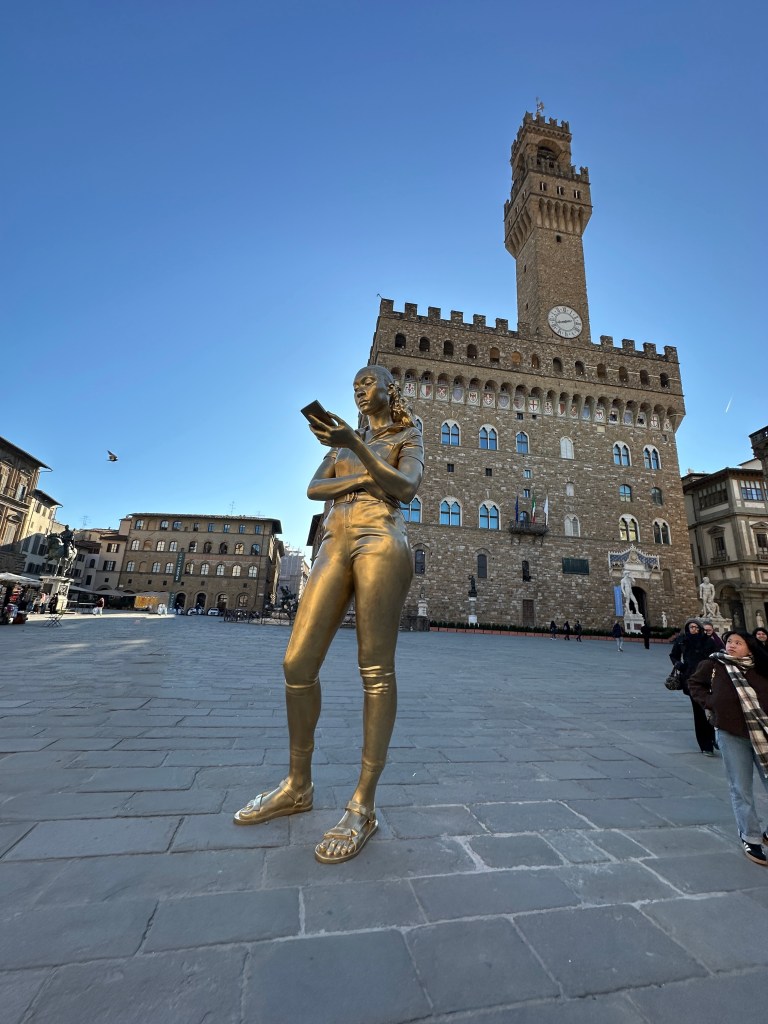
Palazzo Vecchio Florence spring 2025
An interesting study about the importance of digitization by Blaney and Siefring discusses what they call a “culture of non-citation.” They found that although historians increasingly use digital sources in their research, they often cite only the printed versions. This can hide the important role that digital sources actually play in historical research. The authors argue that researchers should acknowledge and cite the digital versions they actually used.
Michelle Moravec raises another important issue: digitized archives create ethical responsibilities, not just new research opportunities. She asks whether historians should freely quote or reuse materials that were originally shared in a limited context but can now be exposed to a much wider audience through digitization. Her main point is that legal access does not automatically make every use ethically acceptable. Historians should also think about privacy, consent, copyright, and possible harm to the people represented in these collections.
References:
Blaney, Jonathan, and Judith Siefring. “A Culture of Non-Citation: Assessing the Digital Impact of British History Online and the Early English Books Online Text Creation Partnership.” Digital Humanities Quarterly Volume 11, no. 1 (2017). https://doi.org/10.63744/rme2max8ep42
Christof Schöch, “Big? Smart? Clean? Messy? Data in the Humanities,” Journal of Digital Humanities 2, no. 3 (Summer 2013), https://journalofdigitalhumanities.org/2-3/big-smart-clean-messy-data-in-the-humanities/
Lara Putnam, “The Transnational and the Text-Searchable: Digitized Sources and the Shadows They Cast,” American Historical Review Volume 131 Issue 2, June 2026.
Moravec, Michelle. “What Would You Do? Historians’ Ethics and Digitized Archives.” On Archivy, Medium, April 14, 2016. https://medium.com/on-archivy/on-april-at-the-organization-of-american-historians-i-participated-in-a-roundtable-discussion-563213dc94a
 Parvin- digitalpast